Inside the Tulum Ruins: A Guide to Every Structure, Temple and Carving
Short answer. Six things are worth your attention: El Castillo on the cliff, the Temple of the Frescoes for its surviving murals, the Temple of the Descending God for its carving, the two big residences, and the wall itself. Ninety minutes covers all of them.
Tulum is a small site with small buildings, and if you arrive expecting Chichén Itzá you will be briefly disappointed until you reach the cliff edge. What you get instead is the best-preserved coastal Maya architecture anywhere, several buildings that still carry their carving, and a setting nothing inland can match. Walk it in this order and you will not miss anything.
What you are looking at before you look at anything
Almost every wall you are looking at was originally rendered in stucco and painted, much of it red. The rough limestone that reads to you as ruin is the structure, not the finish. You will also notice the walls lean slightly outward from the base — a habit of Postclassic east-coast building, and once you have seen it you cannot unsee it.
The buildings at a glance
| Structure | What it is |
|---|---|
| El Castillo | The building everyone photographs, and the reason the postcards look the way they do. |
| Temple of the Frescoes | The most informative building on the site and the one most people walk past. |
| Temple of the Descending God | A small building on the north side of El Castillo, named for the figure above its doorway: an upside-down human form, head down and legs up, arms held to the sides, as though diving. |
| House of the Halach Uinic | Named for the title of a Maya ruler — roughly “the real man”, the highest office in a Maya polity. |
| House of the Columns | One of the larger residential buildings in the walled area, with the row of columns that gives it its name. |
| The wall | The thing the site is named after. |
El Castillo
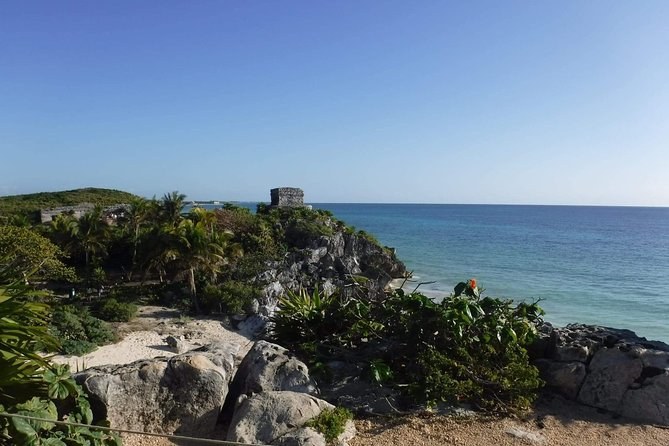
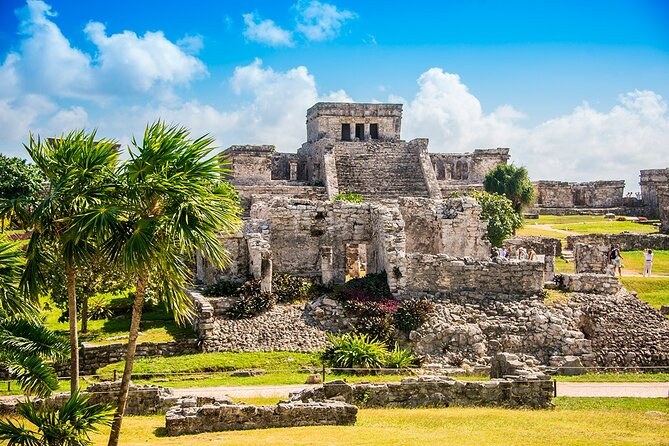
The building on every photograph, and not the pyramid you are expecting. What you are looking at is a broad, low platform on the cliff edge with a wide central stair and a squat temple on top, its doorway split by two columns. The temple stands about 7.5 metres above its platform; the platform stands on a twelve-metre cliff. The cliff does the work, which is why your photograph looks better than the building alone would suggest.
Two small windows face the sea from the upper chamber. A long-standing reading is that a light shown through them lined up with the one navigable gap in the reef, giving canoes a bearing. It is interpretation rather than proof, but it fits the position and it fits what Tulum was for.
The Temple of the Frescoes
The most informative building here and the one most people walk straight past on the way to the sea. Its inner chamber holds the best-surviving painted murals at Tulum, blue-green figures on a dark ground. Its outer face still carries stucco relief: seated figures, and a mask at each corner of the lower storey.
You view the murals from behind a rope, in poor light. Early morning is the only time the sun reaches far enough in for you to read them, which is one more reason to be at the gate when it opens.
The Temple of the Descending God
Small, just north of El Castillo, and named for the figure above its doorway: a human form carved upside down, head below, legs bent up, arms at the sides, as though diving. The same figure repeats elsewhere on the site.
Who he is has never been settled. The readings run from the setting sun to Venus to a bee god associated with honey on this coast. Any guide who tells you flatly which one has picked a story rather than reported a finding. The meaning page sets out what the evidence actually supports.
The residences
The House of the Halach Uinic takes its name from the title of a Maya ruler — roughly “the real man”. It is large, colonnaded, and carries more descending figures. Whether a ruler lived in it is inference from size and position, not from a text. The House of the Columns is the other big one, and when you reach them you have moved from the temples into the town.
The wall
The thing the place is named after, and the easiest for you to overlook because you walk through it in the first ten seconds of your visit. It runs three landward sides, three to five metres thick and about as high, with narrow gateways and raised corner positions. The fourth side is the cliff.
Stop at a gateway. Look at how little of it there is. A wide ceremonial entrance and a gap two people can pass through are different decisions, and this is the second kind.
The beach stair, and the platform above it
A wooden stair drops from the platform to a small cove directly below El Castillo. When it is open, it is the one place you can stand and look back up at the building from underneath, which is the photograph almost nobody comes away with. It closes for sea conditions and for turtle nesting between roughly May and October, so treat it as a bonus.
The platform itself is worth two minutes of your attention on its own. You are standing on a natural limestone shelf that the builders barely modified, which is why the wall stops here — the drop did the job a wall would have done.
What it looked like when it was lived in
Rendered, and painted red. Try it as a thought experiment while you are standing in the plaza: replace every grey surface you can see with smooth red stucco, put roofs of thatch on the residential buildings, and fill the space between them with people. The site you are looking at is the skeleton of that, weathered for five hundred years of salt air. The surviving paint in the Temple of the Frescoes is the only piece of evidence still visible on site, which is why it repays the detour that most visitors do not make.
What is not here any more
One comparison worth making while you are standing here: at Chichén Itzá you are looking at structure and scale, because the painted finish has gone. At Tulum you can still see a little of the surface a Maya builder intended.
Most of Tulum lived outside the wall, in perishable houses that have left nothing. The standing remains are the elite and ceremonial core of a working port. Reading the walled area as the whole city is the commonest mistake, and it is why what Tulum was for is a different question from what is standing.
If you would rather have all of this pointed out to you on the ground, compare the Tulum Ruins guided tours that put a guide in front of the carving.
Frequently asked questions
Can you go inside the buildings at Tulum?
No. The structures are roped off and climbing is not permitted anywhere on the site. The murals in the Temple of the Frescoes are viewed from outside.
Which building should I not miss?
The Temple of the Frescoes. El Castillo is the photograph, but the Frescoes carry the surviving paint and carving, and almost everyone walks past them.
Tours with a guide who reads the carving
Tulum Guided Tour, Magical Cenote, Lagoon Snorkeling and Beachside Lunch
Max 16Lunch
From $119 per person
Want the iconography explained on the spot? Compare guided Tulum Ruins tours.