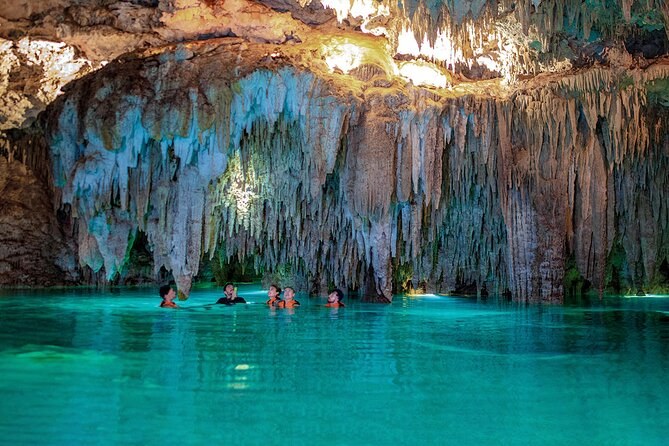
Tulum Guided Tour, Magical Cenote, Lagoon Snorkeling and Beachside Lunch
Max 16Lunch
From $119 per person
Tulum is one of the better archaeological sites to bring children to, and it fails badly if you arrive at midday. Three things decide it: the heat, the walk, and how long you plan to stay.
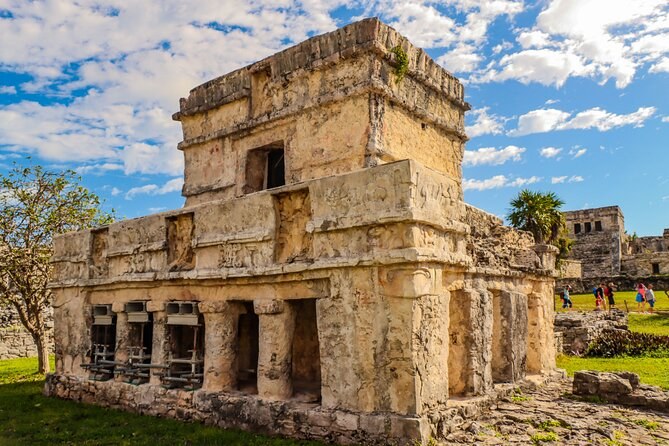
Yes. It is small, it is outdoors, there are iguanas on the stones, and the cliff and the sea hold attention in a way that a room of artefacts does not. Ninety minutes covers the whole site, which is about the right length for most children.
There is essentially no shade inside the walls. Open limestone radiates, and the few trees are not where you will want them. An eight o'clock arrival and an eleven o'clock arrival are two different outings with the same children.
From the car park at the Parque del Jaguar entrance to the archaeological zone gate is the better part of a kilometre. There is a paid shuttle, and with small children it is worth taking. Add twenty minutes each way regardless.
| 2026 | |
|---|---|
| Children under 13 | Free, with ID |
| Adults, INAH ticket | MX$209 |
| Adults, CONANP bracelet | about MX$120–125 |
| Adults, Parque del Jaguar | about MX$180–295 |
| Typical adult total | roughly MX$515–622 (about US$28–35) |
Tour operators usually charge a reduced child rate, which is separate from the gate.
If you are choosing one Maya site to take children to, it is this one. Tulum is ninety minutes on a compact circuit with the sea in view; Chichén Itzá is a twelve-hour day with two and a half hours of driving at each end. The scale is more impressive and the day is far harder.
Book the earliest departure you can find, or drive yourself and be at the gate for eight. Do the ruins first, while everyone is fresh and the stone is still cool, and keep it to an hour if attention is going. Then take the cenote, which is the reward and the cool-down and the thing they will talk about afterwards. Be back for lunch. A Tulum day that ends at one o'clock is a success; one that runs to four in the afternoon heat with tired children is the version people write bad reviews about, and the difference between them is almost entirely what time you started.
Nothing can be climbed and nothing can be touched. Buggies are awkward on the paths, and the walk in from the car park with one is a slog. The beach stair below the ruins is closed more often than it is open.
Ninety minutes is the honest number, and it happens to be exactly how long the site takes. That is the single reason Tulum works with children where a larger site does not: you are not asking them to walk four kilometres between building groups in the sun, you are asking for an hour and a half on a compact circuit with the sea in view most of the way.
Where families come unstuck is the total elapsed time. Ninety minutes on site becomes four hours once you add the drive from Playa del Carmen, the walk in, the ticket queue and the walk back. From Cancun it becomes seven or eight. Judge the day by the door-to-door figure, not by the time at the ruins.
Under four. Carry them. The paths are uneven, the walk in is long, and there is nowhere shaded to stop. It is doable and plenty of people do it, but it is a carrying day rather than a walking one.
Four to eight. The sweet spot, provided you go early. The iguanas, the cliff, the hunt for the upside-down figure and a cenote afterwards is a genuinely good day at this age. Keep the history light — one or two things they can look for beats a narrative.
Nine and up. Old enough for the story to land. This is the age at which the fact that the city was still occupied when European ships arrived stops being a date and starts being interesting, and where a good guide earns their fee.
Be honest with yourself about this when you choose. For most children under about ten, the ruins are forty-five minutes of moderate interest and the cenote is the day. That is not a problem — it is an argument for booking one of the combination tours rather than a ruins-only departure, and for doing the ruins first while everyone is fresh.
Cenotes on these tours vary from open pools to cave systems. The cave ones are spectacular and can be intimidating for a nervous swimmer; the open ones are easier. Life jackets are provided on every departure that includes one.
There is nothing to buy inside the walls and no shade to eat it in. Toilets are in the entrance area, before you pass into the archaeological zone, which means going before you go in rather than when someone announces they need to. Most tours provide water and a snack; several provide a full lunch, and on a long day with children that is worth paying for.
A combination tour with a cenote gives the day a second act and a swim after the heat. A small-group departure means less standing about. A private half-day means you set the pace and leave when you have had enough, which with young children is worth the difference.
The full set, with group caps on every card, is on Tulum Ruins Tours.
Children under 13 enter free with identification. Tour prices are separate and most operators charge a reduced child rate.
You can, but the paths are uneven limestone and the walk in from the car park is long. A carrier is easier for the smallest children.
From $119 per person
Pick a morning start and a cenote stop — compare Tulum Ruins tours for families.