12 Facts About the Tulum Ruins That Will Surprise You
Short answer. The name means wall. The older name means dawn. The city was still lived in when the first Spanish ship sailed past in 1518, and the figure carved over one doorway is upside down and nobody is certain who he is.
Twelve things about Tulum that are either not widely known or will contradict what you are expecting when you walk in. Several of them will change how you look at the place, and one of them will change what you budget.
1. The name just means “wall”
Yucatec Maya for wall, or fence. It describes the rampart, and it is a later name. Nobody who lived here would have called the city that.
That is less unusual than it sounds. A great many of the Maya site names you will meet on this peninsula are descriptions applied afterwards, by people arriving at an abandoned place and naming the most obvious thing about it. What is unusual at Tulum is that we also have the older name, and that the two describe completely different things: one the defence, the other the direction the city faces.
Worth saying out loud at the gate. Guides use Tulum for the site, Zamá for the older city and El Castillo for one building on it. The meaning page untangles which is which.
2. Its older name means “dawn”
Zamá. The city faces east, and the sun comes up out of the Caribbean directly in front of El Castillo.
3. It was still occupied when Europeans arrived
A Spanish expedition under Juan de Grijalva coasted past in 1518 and recorded a walled city on the shore. Tulum was working at that moment. The idea that Maya civilisation had collapsed centuries earlier does not survive a visit here.
It is worth sitting with that for a moment while you are on the cliff. The people who built and used these buildings were not a vanished civilisation being rediscovered. They were a functioning coastal polity that watched a foreign ship go past, and whose descendants still live in this part of Mexico and still speak Yucatec Maya.
4. What emptied it was disease, not conquest
Occupation ended within decades of contact. Introduced epidemics collapsed coastal populations faster than any army did.
5. El Castillo is not a pyramid
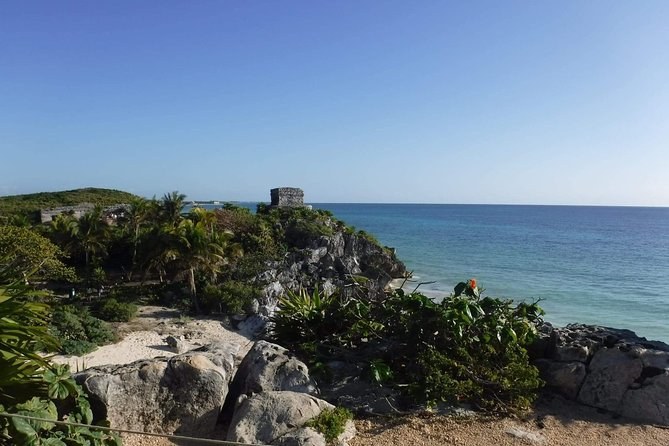
It is a broad, low platform with a temple on top. What makes your photograph is the twelve-metre cliff underneath it, not the height of the building — which is why you should shoot it from the north, looking back along the cliff.
6. There is a carving of a man diving, and nobody knows who he is
The Descending God, above the doorway of the temple named after him. Head down, legs up, arms at his sides. Candidates include the setting sun, Venus and a bee god. None is proven.
7. The whole thing was painted
Red, mostly, over stucco. The bare grey limestone you are photographing is the structure underneath a finish that has weathered off everywhere except the Temple of the Frescoes — which is where you should go to see what the rest of it once looked like.
8. Very few Maya cities have a wall
Tulum's is three to five metres thick on three sides. Walls are rare and late in the Maya world, and they appear when the political order that kept the peace has gone.
9. Most of the city is missing
Only the elite quarter was inside the wall. The bulk of the population lived outside it in perishable buildings that have left nothing at all.
So the site you walk round is not a town, it is a town's administrative and religious centre with the town deleted. Estimates for the walled area run to something in the region of a thousand to sixteen hundred people. Everyone else — the crews, the porters, the people who actually loaded the canoes — lived in houses of wood and thatch on the ground you drove in across.
10. It became famous because of two Victorians
John Lloyd Stephens and Frederick Catherwood reached it in 1841. Catherwood's drawings recorded facade detail that has since weathered to bare stone, which makes them primary evidence rather than illustration.
11. The entrance fee doubled this year
The INAH archaeological ticket went from MX$104 to MX$209 on 1 January 2026, as part of a national revision across 193 sites.
The one that will affect your morning. Budget for three charges, not one, and take pesos. The visiting page has the breakdown.
12. You now pay three organisations, not one
Since Parque del Jaguar opened in late 2024 the ruins sit inside a national park, and INAH, CONANP and the park each charge you separately. It is the single most common surprise at the gate, and the reason no two tour listings you compare will quote the same total.
13. It is the opposite of Chichén Itzá
The two sites people compare are answering different questions. Chichén Itzá is inland, monumental and built to impress. Tulum is small, coastal and built to work — a port with temples attached rather than a ceremonial capital. Neither is a lesser version of the other.
14. The reef gap is the reason any of it is here
A reef runs almost continuously along this coast, and a loaded seagoing canoe cannot cross one. Tulum sits on one of the few breaks in it. Everything else about the city — the wall, the elite quarter, the buildings facing the water — follows from that single piece of geography. It is a customs post with temples, and the temples face the thing that paid for them.
15. Two windows in El Castillo may have been a lighthouse
The upper chamber has two small openings facing the sea. A long-standing reading is that a light shown through them lined up with that gap in the reef, giving canoes coming in off open water a bearing to steer. It is an interpretation rather than a demonstrated fact, and you should treat any guide who states it flatly with mild suspicion — but it fits the architecture, it fits the position, and it fits what the city was for.
What changed in 2024, and why it still confuses people
Before Parque del Jaguar, Tulum was a gate, a ticket and a car park close to the entrance. Now the archaeological zone sits inside a national park, you park further out, and you walk the better part of a kilometre or pay for the shuttle. Most of the guidance you will find online was written before that and describes a visit that no longer exists.
It is also why the reviews on the tour listings are worth reading by date. Anything written before late 2024 describes different logistics and a different price.
The thing most visitors get wrong about the size
People budget half a day and need ninety minutes. The walled area is about 400 metres by 170 — you can see one end from the other. What takes the time is not distance, it is the heat and the queue at the gate. If you have set aside a full day for Tulum, you have either planned a cenote into it or you have over-planned.
| What people expect | What is true |
|---|---|
| A tall stepped pyramid | A low platform on a high cliff |
| One ticket | Three separate charges |
| Grey stone city | Originally rendered and painted red |
| Abandoned long before contact | Occupied and working in 1518 |
| You can climb it | You cannot climb anything here |
If any of that made you want a guide who can tell you which readings are solid and which are stories, the departures are compared on Tulum Ruins Tours.
Frequently asked questions
What is the Descending God at Tulum?
A human figure carved upside down above a temple doorway, repeated elsewhere on the site. Readings include the setting sun, Venus and a bee god; none is settled.
Was Tulum still inhabited when the Spanish arrived?
Yes. Grijalva's expedition sighted an occupied walled city from the sea in 1518. Occupation ended within a few decades, from introduced disease.
Tours that go beyond the photograph
Hear the rest on site — compare Tulum Ruins guided tours and pick a guide.